

During my recent travels in Sarawak, I visited the open house of the Borneo Laboratory on 6 March 2026.
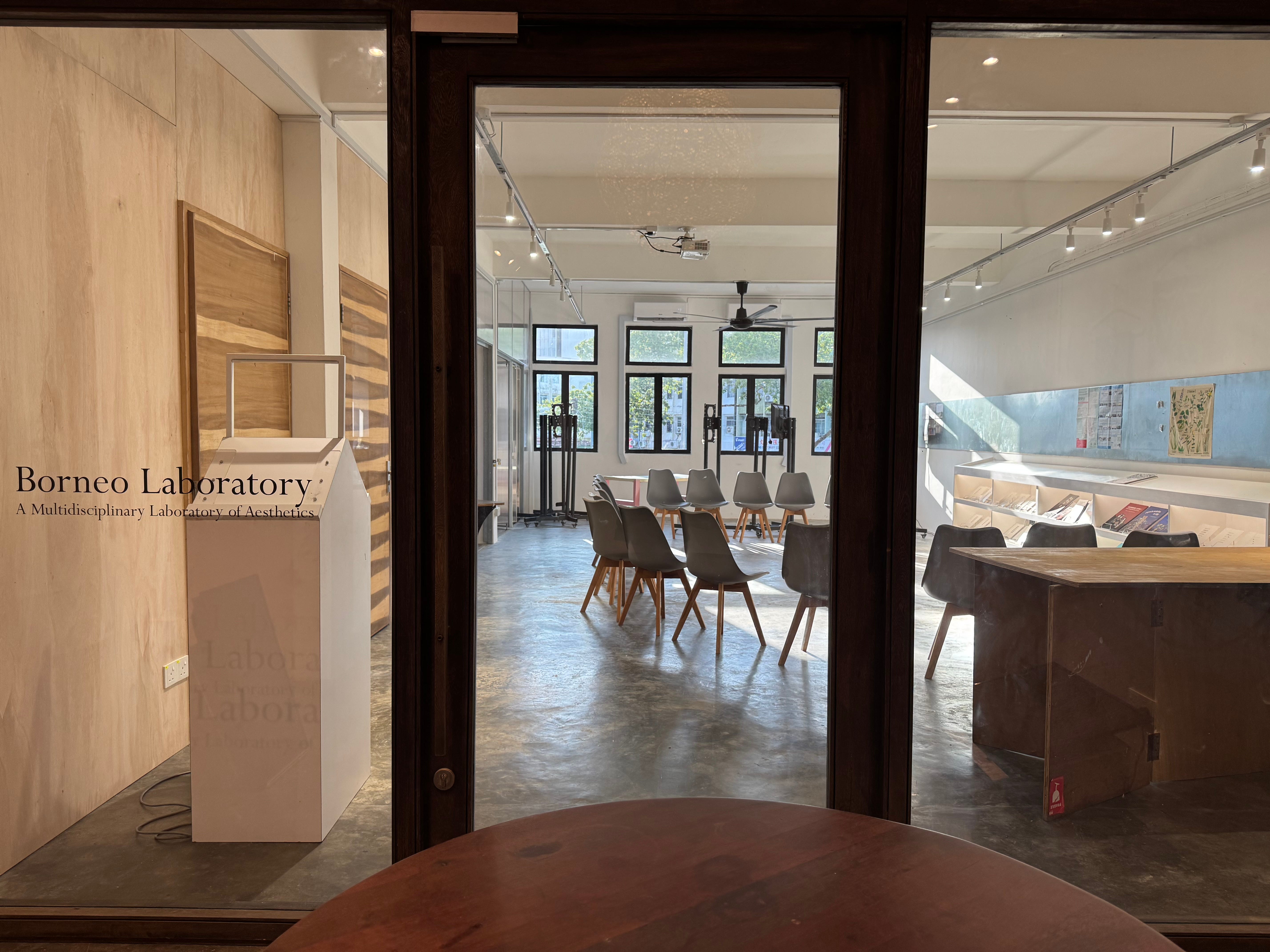
Located at Think & Tink near Jalan Ang Chen Ho 2300 Kuching, the Borneo Laboratory is a space for artists, curators, cultural practitioners, and researchers to explore new ways of producing and sharing knowledge through community-centred collaborations and open dialogue. It is inspired by the local Iban concept of ‘berjalai’, referring to the travelling of ideas as the Borneo Laboratory converses with the wider world.
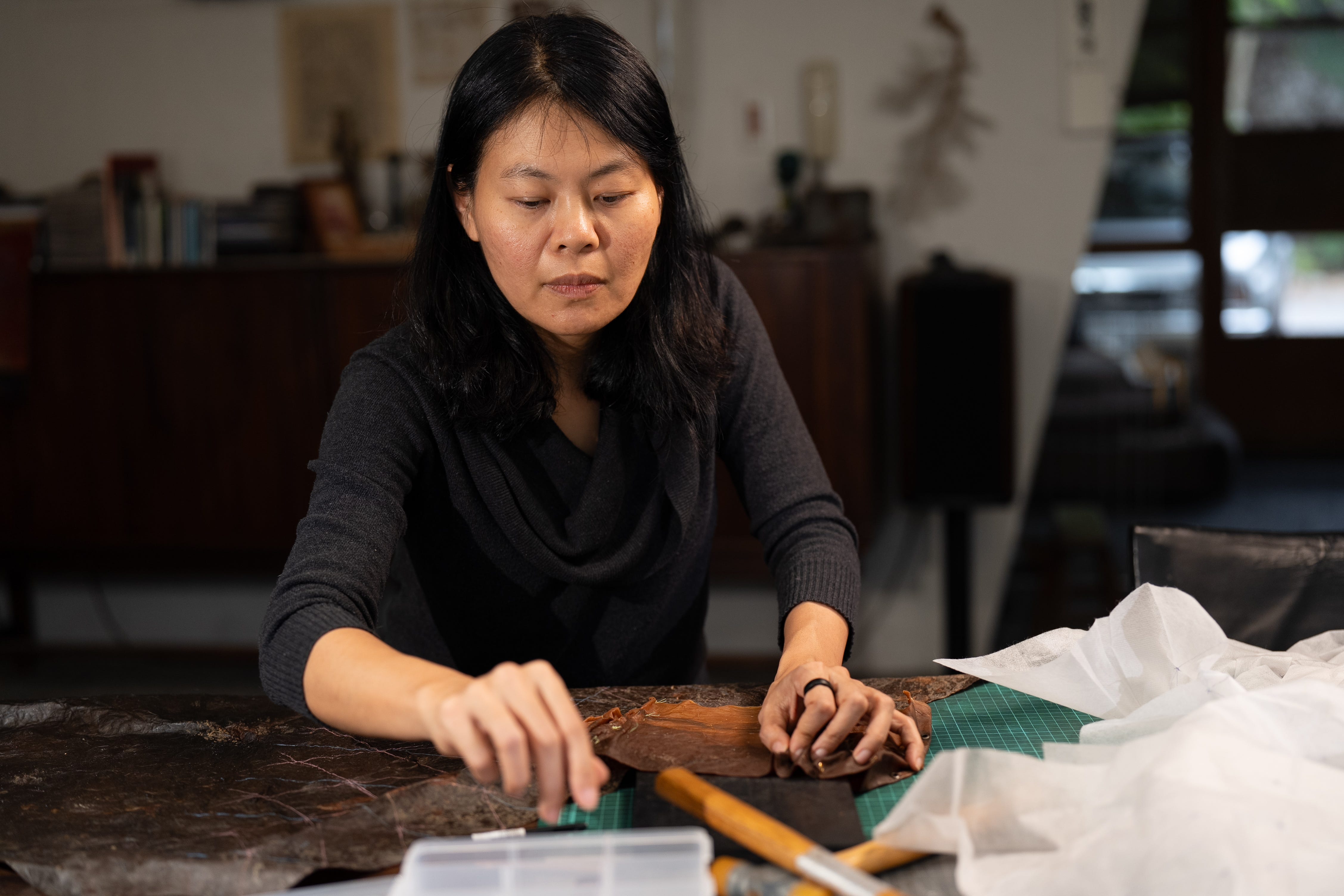
The brain behind the Borneo Laboratory is Wendy Teo. She is a Malaysian-born UK/ARB-RIBA charted architect, curator, and researcher, whose work focuses on embedding socio-cultural dialogue into design. I interviewed Wendy to learn more about her work and how she relates to larger debates about Bornean heritage. An interesting conversation about knowledge, power, and relationality unfolded.
Interdisciplinarity
One of the first topics of discussion was interdisciplinarity. In simple terms, interdisciplinarity means working "inter” (i.e., between) and across diverse disciplines of study. This is one of the core approaches of the Borneo Laboratory. Wendy explained that:
“In the past, when we talked about interdisciplinary or multidisciplinary perspectives, many people could not get it. A lot of people still wanted to view people or things within boxes. However, I was interested in approaching knowledge beyond disciplines because some knowledge can only be investigated through methods or approaches inspired by disciplines other than your own. Otherwise, you will always circle back to similar answers.”
As a critical reader, you may wonder why interdisciplinarity matters beyond simply producing knowledge. We can research and understand phenomena in society through one discipline, so what is the added-value of interdisciplinarity? And, why does interdisciplinarity matter within the Borneo Laboratory? Wendy’s answer is grounded in two closely related principles.
First, interdisciplinarity nurtures best practices. Wendy stated that:
“We are cultural and artistic practitioners working in the field with the communities; either project-based or long-term. We also need to be informed about the limits of existing knowledge and institutional sensitivities. That is the advantage of the Borneo Laboratory’s interdisciplinarity that allows us to have space for hosting this kind of fluid knowledge co-creation with peoples from diverse fields, including academia. Then, we can collaboratively discuss what went right and what went wrong”.
Second, interdisciplinary work contributes to the decolonisation of knowledge. As Michel Foucault (1926-1984) and many other critical thinkers remind us, knowledge is power. As today’s world has been shaped by colonial power structures, the violence of colonialism is not only physical but also embedded in knowledge hierarchies. Postcolonial feminist Gayatri Chakravorty Spivak (1988) identified the latter as epistemic violence, referring to the systematic destruction and delegitimisation of alternative ways of knowing by dominant powers. This process has been inextricably bound up with colonialism as colonial powers used the imperial imposition of law and education to marginalise Indigenous knowledge systems.
We can understand the persistence of epistemic violence from colonialism as the coloniality of knowledge (see for example, De Sousa Santos, 2014; Quijano, 2000; Mignolo, 2007). This means that even after formal colonial rule has ended, colonial thought continues to rule knowledge production. We should not overlook the nuances and complexities of colonialism, such as internal colonialism within postcolonial nation-states. Yet, an introductory understanding of the coloniality of knowledge is that the world continues to be framed by Eurocentric education, logic, and culture as the only universal truths at the expense of non-European and Indigenous ways of knowing, being, and doing (Carpenter, 2025, October 13).
Against this background, Wendy explained how interdisciplinarity challenges the coloniality of knowledge:
“When we put these critical reflections [on best practices from interdisciplinary work] into the picture, it helps us understand certain ways of doing and becoming that challenge colonial legacies. This notion of decolonial work is especially relevant in our area of Borneo. Knowledge that comes from ‘exotic places’ like Borneo is highly contested because much of the existing knowledge is based on the colonial history between Britain and Borneo. After Alfred Russel Wallace, a lot of [foreign] researchers came over here and presented their knowledge to the West in Eurocentric ways. This is highly contested. So, how do we address this? How do we have a different way of producing knowledge or even co-producing knowledge? The decoloniality of knowledge is something the Borneo Laboratory is interested in. To do so, we need to learn about the epistemological sensitivities of others. We are fortunate to have the interdisciplinary space to carry out this critical conversation”.
Knowledge co-creation
Continuing our conversation about knowledge production, I asked Wendy about pressing knowledge issues for the Borneo Laboratory. In the context of the (de)coloniality of knowledge, her perspective centres knowledge co-creation:
“I think that some people are too focused on the verification of knowledge rather than the question of how knowledge could help us embark on making things better. The [legitimacy] intention is not really landing us towards a path that helps the environment to be better, challenges some of the war issues that we have, or resolves environmental issues like the scarcity and fair allocation of resources. I find it important to ask how all these intellectual ambitions of knowledge production can be focused on meaningful co-creation”.
By working collaboratively, we not only enrich critical understandings of socio-cultural phenomena. We can create a positive social impact through knowledge co-production.
Many critical theorists discuss epistemological pluralism as a pillar of the decoloniality of knowledge, meaning that multiple ways of knowing co-exist in non-hierarchical ways (e.g., Agathangelou & Ling, 2009; Ling, 2019; Smith, 2022). On the one hand, we can relate knowledge co-creation to interdisciplinarity, whether it is directly through teamwork or indirectly by drawing on the groundwork laid by others. On the other hand, knowledge co-creation goes beyond disciplines as institutionalised fields of study by working with marginalised voices and knowledge systems outside those institutions, such as Indigenous communities and activist groups. The Borneo Laboratory embodies such multilayered knowledge co-creation.
To connect the practice of knowledge co-creation with the decoloniality of knowledge, I end this section with the following lesson.
Knowledge co-creation can redistribute the powers behind knowledge production towards meaningful visibility and recognition that centres the agency of those who have historically been silenced.
Rethinking heritage
As I wanted to learn more about local debates on heritage, I then asked Wendy: How do you understand heritage?
Admittedly, this question is rooted in my academic training. Through a Critical Heritage Studies lens, heritage is not the neutral preservation of the past but a discourse through which a community negotiates identity, memory, and power (Smith, 2006).
Wendy’s answer:
“Coming from an educational background in architecture, specifically heritage buildings, I saw heritage for a long time as something fixed or static that can be defined along the lines of buildings, structures, and things. Over time, however, I began to think more about my ancestors and community-elders who could not continue certain cultural practices and lifeways. This is something I witnessed in projects within the Borneo Laboratory as well. For example, the Serumpun Project highlights how the disruptions of ancestral relations through the introduction of new things can cause discontinuity.”
She elaborated on the idea of heritage as a site of construction:
“I was working with the aunties and uncles from local communities who tell me stories about what passes down from their ancestors, what they are not practising anymore because of shame, and what they are still practising because of needs. So, I no longer see heritage as something fixed. Heritage is fluid, relational, created, and political”.
What I learnt is that a Critical Heritage Studies lens is not abstract but very much lived and experienced on the ground in Borneo.
Wendy’s hopes for the future
In a time of rising geopolitical tensions, climate change, and other atrocities, I asked Wendy what she hopes for the future. Her answer:
“I wish that people return to our humanness, or humanity. I wish that people reject the bad practices of dishonesty, lack of accountability, and extraction whilst embracing good practices of relational integrity and accountability. I do not ask for complex things or new ethical standards. It is simply about returning to being human in interconnection with more-than-humans. We should not just say things but actually do, be(come), and embody best practices in the sense of community engagement, honesty, and accountability.”
The most striking insight from our conversation might thus be the simplest.
Not a new framework or a trendy concept, but a reminder. What is at stake is something far more basic: how we relate to one another.
Or, as Wendy put it: a return to being human.
The notion of returning to being human ties to the ongoing academic debate on relational heritage. A debate that is present in my research. A debate that is present in Borneo.
Thank you Wendy Teo for sharing your perspectives and experiences.
References
Agathangelou, A. M., & Ling, L. H. (2009). Transforming world politics: From empire to multiple worlds. Routledge.
Carpenter, Y. (2025, October 13). Eurocentrism and coloniality of knowledge in contemporary contexts. Decolonial Centre. https://decolonialcentre.org/2025/10/13/eurocentrism-and-coloniality-of-knowledge-in-contemporary-contexts/
De Sousa Santos, B. (2014). Epistemologies of the South: Justice against epistemicide. Routledge.
Ling, L. H. M. (2019). Kōanzing IR: Flipping the Logic of Epistemic Violence. In K. Shimizu (Ed.), Critical International Relations in East Asia: Relationality,
Subjectivity, and Pragmatism (pp. 64–85). Routledge.
Mignolo, W. D. (2007). Coloniality of power and de-colonial thinking. Cultural Studies, 21(2–3), 155–167. https://doi.org/10.1080/09502380601162498
Quijano, A. (2000). Coloniality of power and eurocentrism in Latin America. International Sociology, 15(2), 215–232. https://doi.org/10.1177/0268580900015002005
Smith, L. (2006). Uses of heritage. Routledge. https://doi.org/10.4324/9780203602263
Smith, L. T. (2022). Decolonizing methodologies : research and indigenous peoples (Third edition.). Zed Books. https://ebookcentral.proquest.com/lib/uvanl/detail.action?docID=6605401
Spivak, G. C. (1988). Can the subaltern speak? In C. Nelson & L. Grossberg (Eds.), Marxism and the interpretation of culture (pp. 271–313). University of Illinois Press.